
Introduction: Why These Temperatures Matter More Than You Think
Imagine you are managing a plant where cooling towers are running, HVAC systems are installed, and product quality depends on environmental conditions.
You might think:
👉 “Temperature is just temperature.”
But in reality, temperature has multiple faces.
- One tells you how hot the air is (Dry Bulb)
- One tells you how much cooling is possible (Wet Bulb)
- One tells you how much moisture is present (Relative Humidity)
These three parameters silently control:
- Cooling tower efficiency
- HVAC performance
- Worker comfort
- Product quality
- Energy consumption
If you misunderstand them, you lose efficiency, money, and control.
Let’s break it down in the simplest possible way.
1. What is Dry Bulb Temperature (DBT)?
Definition:
Dry Bulb Temperature is the actual air temperature measured using a standard thermometer.
👉 No moisture effect
👉 No evaporation
👉 Just pure air temperature
Simple Understanding:
If you check temperature on your phone or weather app → That’s Dry Bulb Temperature
Example:
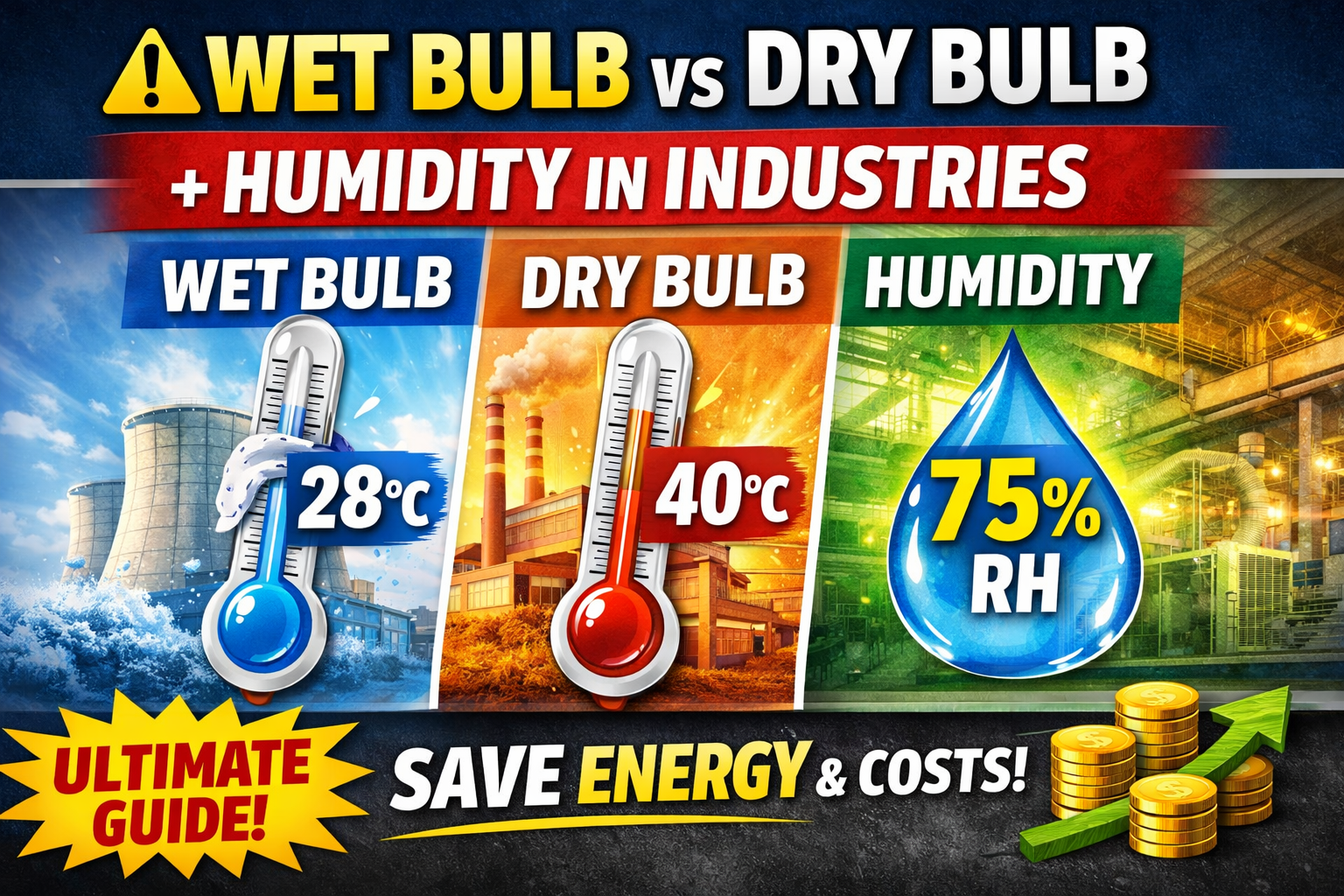
- Outside air temperature = 40°C
- That means DBT = 40°C
Industrial Importance:
- Used in HVAC design
- Basis for heat load calculations
- Determines comfort conditions
2. What is Wet Bulb Temperature (WBT)?
Definition:
Wet Bulb Temperature is the lowest temperature that air can reach through evaporation.
It is measured using:
- A thermometer wrapped in a wet cloth
- Air is passed over it
Simple Understanding:
👉 When water evaporates → it absorbs heat → cooling happens
So:
- More evaporation = more cooling
- Less evaporation = less cooling
Example:
- Dry Bulb = 40°C
- Wet Bulb = 28°C
👉 This means air can cool down to 28°C maximum by evaporation
Why Wet Bulb is CRITICAL in Industry
Wet bulb temperature directly decides:
- Cooling tower performance
- Air cooling capacity
- Evaporative cooler efficiency
👉 You CANNOT cool below wet bulb temperature using evaporation
This is a fundamental industrial limitation.
3. What is Relative Humidity (RH)?
Definition:
Relative Humidity is the percentage of moisture present in air compared to the maximum it can hold at that temperature.
Formula:
RH=Maximum Moisture CapacityActual Moisture×100
Simple Understanding:
- RH = 100% → air is fully saturated (rain possible)
- RH = 50% → air holds half its capacity
Relationship Between DBT, WBT & RH
These three are interconnected.
| Condition | DBT | WBT | RH |
|---|---|---|---|
| Dry Air | High | Low | Low |
| Humid Air | Close | Close | High |
| Saturated Air | Equal | Equal | 100% |
👉 Key Insight:
When RH = 100%, DBT = WBT
4. Psychrometric Chart – The Industrial Bible
A psychrometric chart shows:
- DBT
- WBT
- RH
- Dew point
- Enthalpy
Manager-Level Understanding:
Instead of guessing:
👉 Engineers use this chart to predict air behavior
Used in:
- HVAC design
- Cooling tower analysis
- Drying processes
5. Practical Calculations
Case 1: Cooling Tower Example
Given:
- DBT = 38°C
- WBT = 28°C
🔍 Approach:
Cooling tower outlet temperature depends on WBT
👉 Typical approach:Cold Water Temp=WBT+Approach
If approach = 4°C:Cold Water=28+4=32°C
👉 You cannot go below 28°C
Case 2: Relative Humidity Estimation
Given:
- DBT = 35°C
- WBT = 25°C
Approx RH from charts ≈ 50–55%
Case 3: Efficiency of Cooling Tower
Efficiency=Hot Water−WBTHot Water−Cold Water×100
Example:
- Hot water = 42°C
- Cold water = 32°C
- WBT = 28°C
Efficiency=42−2842−32×100=1410×100=71.4%
👉 Good industrial performance
6. Industrial Applications
🔹 1. Cooling Towers
- WBT determines minimum cooling limit
- Lower WBT = better cooling
🔹 2. HVAC Systems
- DBT controls comfort
- RH controls air quality
🔹 3. Textile Industry
- High RH needed for fiber strength
🔹 4. Food Industry
- RH controls shelf life
🔹 5. Power Plants
- Cooling efficiency depends on WBT
7. Why You Can’t Cool Below Wet Bulb Temperature
This is one of the most misunderstood concepts.
Logic:
Evaporation requires:
- Dry air
- Heat transfer
When air is fully saturated:
👉 No more evaporation
👉 No more cooling
Thus:
👉 Wet bulb temperature is the theoretical cooling limit
8. Real-Life Example
Summer Day:
- DBT = 42°C
- RH = 20%
- WBT ≈ 25°C
👉 Cooling tower works GREAT
Monsoon Day:
- DBT = 32°C
- RH = 90%
- WBT ≈ 30°C
👉 Cooling tower struggles
9. Manager-Level Insights (Very Important)
💡 Insight 1:
Always monitor Wet Bulb, not just temperature
💡 Insight 2:
High humidity reduces cooling efficiency
💡 Insight 3:
Design systems based on worst-case WBT
💡 Insight 4:
Energy costs increase with high RH
10. Common Mistakes in Industry
❌ Ignoring wet bulb temperature
❌ Designing systems only on DBT
❌ Not monitoring RH
❌ Oversizing equipment unnecessarily
11. Comparison Summary
| Parameter | Dry Bulb | Wet Bulb | Relative Humidity |
|---|---|---|---|
| Measures | Air temp | Cooling potential | Moisture % |
| Tool | Thermometer | Wet thermometer | Hygrometer |
| Use | HVAC | Cooling towers | Comfort |
12. Practical Tips for Engineers & Managers
✔ Always install wet bulb sensors
✔ Use psychrometric charts
✔ Track seasonal variations
✔ Optimize cooling tower approach
✔ Control RH in sensitive processes
13. Energy & Cost Impact
Better understanding leads to:
- Lower electricity bills
- Improved equipment life
- Better process control
👉 Small awareness = BIG savings
Conclusion: Think Beyond Temperature
Temperature is not just a number.
It is:
- Dry Bulb → what you feel
- Wet Bulb → what you can achieve
- Relative Humidity → what controls the system
If you master these:
👉 You move from operator → decision-maker → leader
Call to Action
If you are working in:
- Power plants
- HVAC
- Process industries
👉 Start tracking Wet Bulb Temperature daily
Because:
“You cannot control what you don’t measure.”