
High IQ may get you hired. High EQ helps you get promoted. High SQ helps you stay fulfilled while succeeding.
Introduction
Imagine two engineers graduating from the same college.
Both score above 90%.
Both possess exceptional technical knowledge.
Both join the same company.
Five years later…
One becomes a respected leader, manages a successful team, and inspires everyone around him.
The other is still technically brilliant but struggles with conflicts, stress, poor communication, and career growth.
What created this difference?
Not intelligence.
Not education.
Not experience.
The answer lies in two abilities that traditional education rarely teaches:
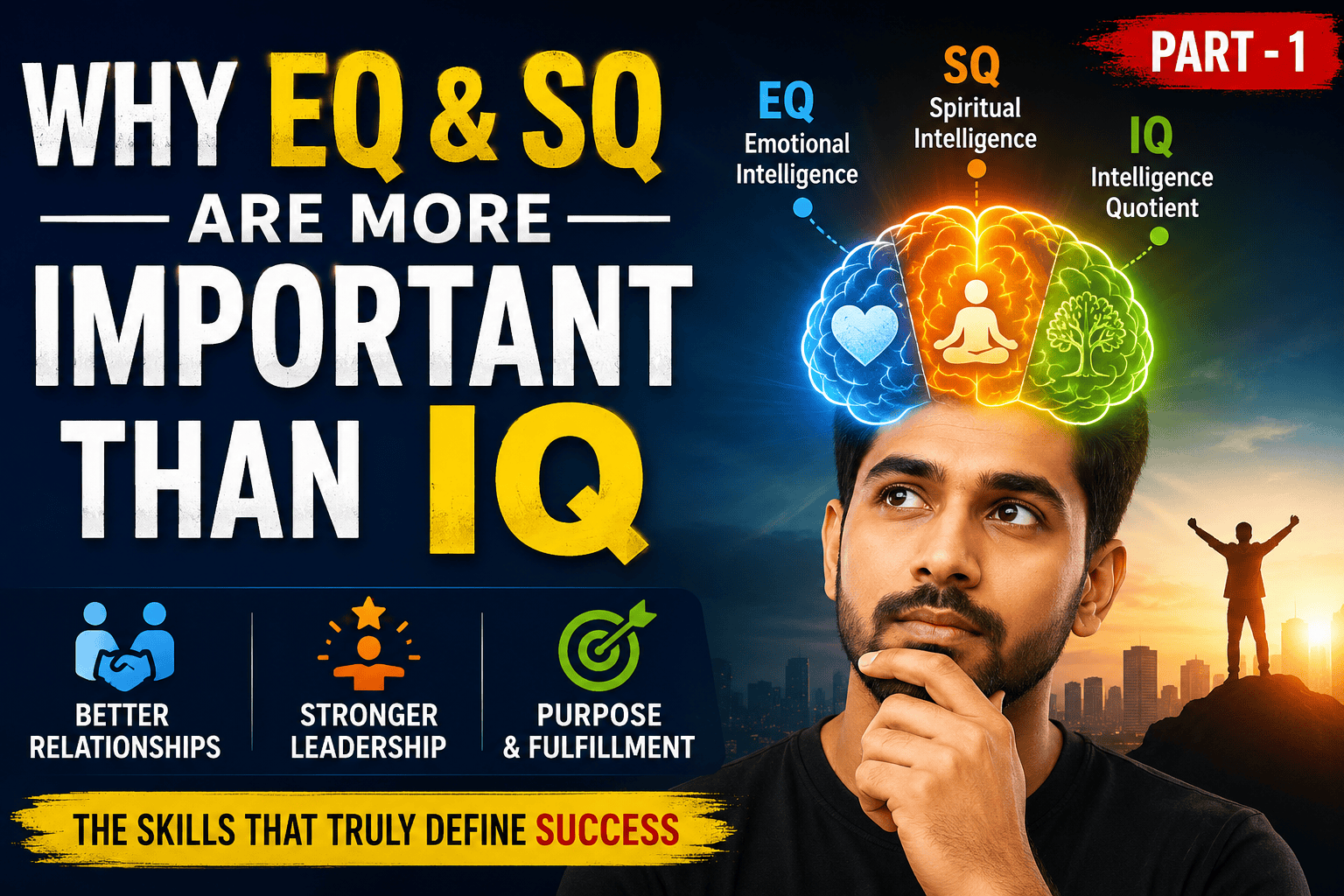
- Emotional Intelligence (EQ)
- Spiritual Intelligence (SQ)
For decades, society measured intelligence using only one parameter—IQ (Intelligence Quotient). High IQ was considered the ultimate predictor of success.
However, today’s world tells a different story.
Artificial Intelligence can now solve mathematical equations, write code, generate reports, analyze data, and even create designs within seconds.
If machines can outperform humans in pure intelligence, what makes humans truly valuable?
The answer is our ability to understand emotions, build relationships, make ethical decisions, adapt to uncertainty, and find purpose in our work.
That is where EQ and SQ become game changers.
In this guide, you’ll learn:
- What IQ, EQ, and SQ actually mean
- Why EQ and SQ matter more than ever
- Real-life examples from business and leadership
- Practical exercises to improve each skill
- Common mistakes professionals make
- A proven framework to develop all three intelligences together
Let’s begin.
Table of Contents
- What is IQ?
- What is EQ?
- What is SQ?
- EQ vs IQ vs SQ
- Why the World is Changing
- Why Companies Hire IQ but Promote EQ
- The Role of SQ in Long-Term Success
- Real-Life Examples
- Step-by-Step Framework to Improve EQ and SQ
- Common Mistakes
- Expert Tips
- Key Takeaways
- FAQs
- Conclusion
What is IQ?
IQ (Intelligence Quotient) measures a person’s cognitive ability.
It evaluates how efficiently someone can think, analyze, solve problems, and learn new concepts.
Typical IQ assessments include:
- Logical reasoning
- Mathematical ability
- Pattern recognition
- Memory
- Language skills
- Analytical thinking
People with High IQ Usually
- Learn faster
- Solve technical problems quickly
- Perform well in academics
- Understand complex systems
- Excel in engineering and science
For decades, IQ was considered the gold standard for predicting career success.
But research and workplace experience have shown something important.
A high IQ alone does not guarantee:
- Happiness
- Leadership
- Strong relationships
- Teamwork
- Mental resilience
- Ethical decision-making
Many highly intelligent individuals struggle with communication, emotional regulation, and collaboration.
That is why organizations increasingly value qualities beyond raw intelligence.
What is Emotional Intelligence (EQ)?
Emotional Intelligence (EQ) is the ability to recognize, understand, manage, and positively influence emotions—both your own and those of others.
Unlike IQ, which remains relatively stable, EQ can be developed throughout life.
People with high EQ don’t suppress emotions.
They understand them.
They use emotions wisely rather than allowing emotions to control their actions.
The Five Pillars of Emotional Intelligence
| Skill | Meaning |
|---|---|
| Self-awareness | Understanding your emotions |
| Self-regulation | Managing emotional reactions |
| Motivation | Staying driven despite challenges |
| Empathy | Understanding others’ emotions |
| Social skills | Building healthy relationships |
Example
Imagine a project deadline is missed.
Low EQ Manager
“Who made this mistake?”
Blame begins.
The team loses confidence.
Stress increases.
Productivity drops.
High EQ Manager
“Let’s understand what happened and how we can prevent it next time.”
The team feels psychologically safe.
People share honest feedback.
Processes improve.
Trust grows.
The technical problem gets solved—and so does the human problem.
What is Spiritual Intelligence (SQ)?
When people hear “spiritual,” they often think only about religion.
That is a misconception.
Spiritual Intelligence (SQ) is not about religion.
It is about meaning, values, ethics, purpose, and inner wisdom.
SQ helps people answer questions such as:
- Why am I doing this work?
- What kind of leader do I want to become?
- What values will I never compromise?
- How can I contribute to society?
- What gives my life meaning beyond money and status?
People with high SQ make decisions based not only on profit but also on principles.
Characteristics of High SQ
- Integrity
- Humility
- Gratitude
- Compassion
- Ethical leadership
- Long-term thinking
- Calmness during uncertainty
- Service-oriented mindset
Example
Imagine two business owners.
Both earn ₹10 crore annually.
The first cuts corners on safety, underpays employees, and ignores environmental standards to maximize short-term profits.
The second invests in employee well-being, follows safety regulations, treats customers fairly, and focuses on sustainable growth.
Both may appear successful today.
But over time, the second is far more likely to earn trust, attract loyal customers, retain talented employees, and build a lasting reputation. SQ influences decisions that create durable success rather than temporary gains.
EQ vs IQ vs SQ
| Factor | IQ | EQ | SQ |
|---|---|---|---|
| Focus | Intelligence | Emotions | Purpose |
| Measures | Logic | Emotional skills | Values and meaning |
| Helps In | Exams, analysis, problem-solving | Leadership, teamwork, communication | Ethics, resilience, long-term vision |
| Can Improve? | Limited | Yes | Yes |
| Important For | Technical work | Managing people | Leading with purpose |
| Biggest Strength | Analytical thinking | Relationship building | Wise decision-making |
A Simple Analogy
Think of driving a car:
- IQ is the engine—it gives you power.
- EQ is the steering wheel—it helps you navigate people and situations.
- SQ is the GPS—it ensures you’re heading toward the right destination.
A powerful engine without steering can cause accidents. Steering without a destination leads nowhere. True success comes from combining all three.
Why the World is Changing
Twenty years ago, technical expertise alone could build a successful career.
Today, the landscape is different.
Artificial intelligence can write code, generate presentations, analyze large datasets, draft reports, and automate many routine tasks. As technology takes over repetitive cognitive work, human-centered skills become increasingly valuable.
Professionals who thrive are those who can:
- Build trust across teams
- Communicate clearly
- Adapt to rapid change
- Resolve conflicts
- Lead through uncertainty
- Make ethical decisions
- Inspire others with purpose
These capabilities are rooted in EQ and SQ—not IQ alone.
Organizations now seek people who combine technical competence with emotional maturity and principled leadership.
➡️ End of Part 1
In Part 2, we’ll cover:
- Why companies hire IQ but promote EQ
- How SQ creates extraordinary leaders
- Real-world case studies from business and engineering
- The complete 7-step framework to build EQ and SQ
- Daily habits you can start immediately.