
Introduction
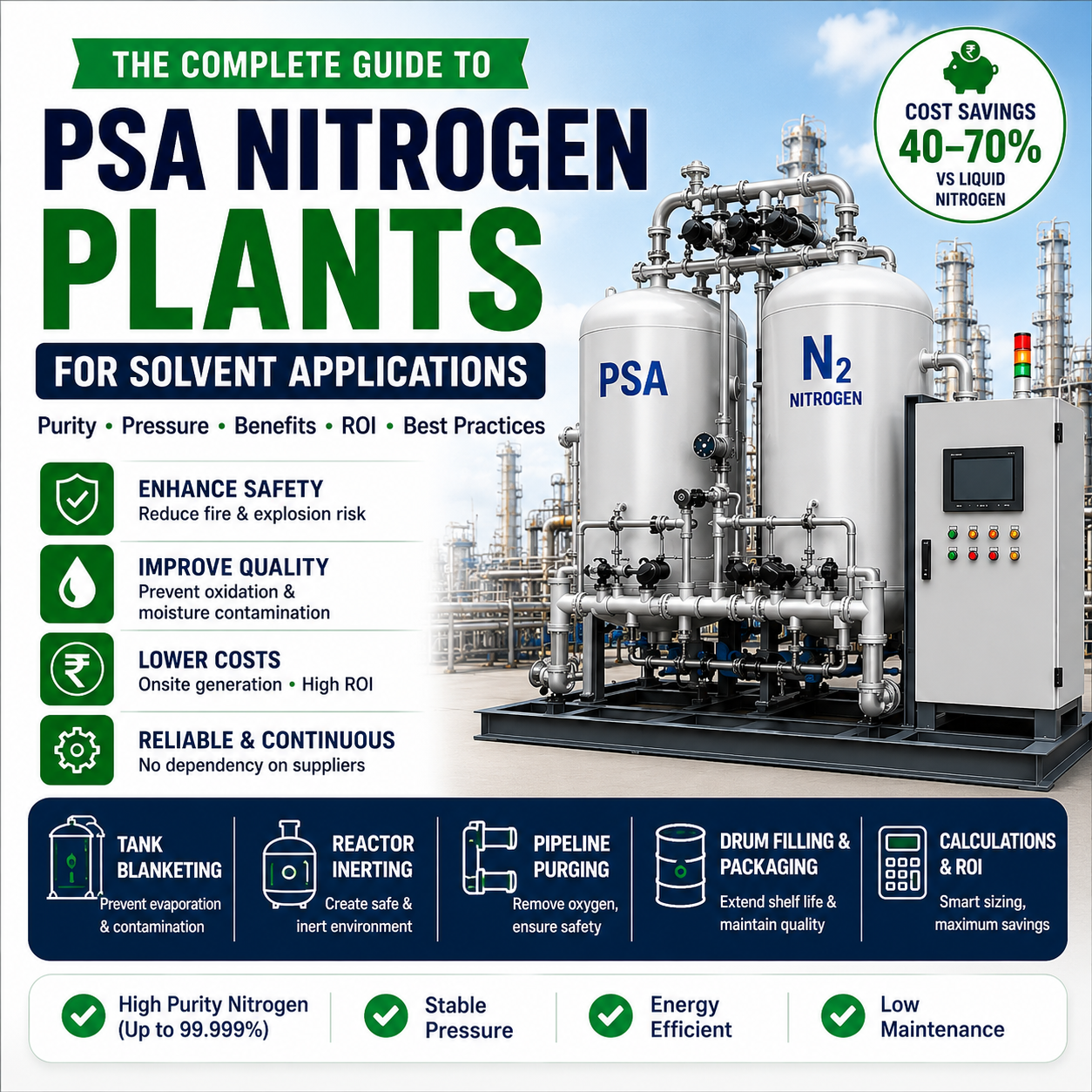
In modern chemical, pharmaceutical, paint, ink, agrochemical, edible oil, and specialty manufacturing industries, solvents are critical for production. However, solvents also introduce major operational and safety risks because many are highly flammable, moisture-sensitive, or oxygen-reactive.
This is where PSA (Pressure Swing Adsorption) Nitrogen Plants become one of the most valuable utilities inside a manufacturing facility.
Nitrogen is used to:
- Prevent fire and explosion
- Protect solvent quality
- Increase shelf life
- Improve process consistency
- Reduce oxidation
- Create inert atmospheres in tanks, reactors, and pipelines
Industries are increasingly shifting from cylinder nitrogen and liquid nitrogen to onsite PSA nitrogen generation because of:
- Lower operating cost
- Continuous availability
- Better process control
- Reduced dependency on suppliers
- Improved safety
This detailed guide explains:
- How PSA nitrogen plants work
- Nitrogen applications in solvent industries
- Required purity and pressure
- Important calculations
- Operating best practices
- Critical maintenance points
- ROI examples
- Safety considerations
What is a PSA Nitrogen Plant?
A PSA nitrogen plant separates nitrogen from compressed air using Carbon Molecular Sieves (CMS).
Atmospheric air contains approximately:
- 78% Nitrogen
- 21% Oxygen
- 1% Argon and other gases
The PSA system selectively adsorbs oxygen molecules under pressure while allowing nitrogen to pass through.
Basic Working Principle
The process operates in cycles:
- Air compressor supplies compressed air
- Air dryer removes moisture
- Filters remove oil and dust
- Compressed air enters CMS towers
- Oxygen gets adsorbed
- Nitrogen exits as product gas
- Towers alternate between adsorption and regeneration
Core Scientific Concept
The adsorption efficiency depends on:
- Pressure
- Flow rate
- CMS quality
- Temperature
- Purity requirement
Why Nitrogen is Critical in Solvent Applications
Many solvents react with oxygen or moisture.
Examples:
- IPA (Isopropyl Alcohol)
- Methanol
- Ethanol
- Acetone
- Toluene
- Hexane
- MEK
- Ethyl Acetate
These solvents can:
- Oxidize
- Absorb moisture
- Create explosive vapors
- Degrade product quality
Nitrogen creates an inert atmosphere that minimizes these risks.
Major Uses of Nitrogen in Solvent Industries
1. Tank Blanketing
One of the most common applications.
Nitrogen is maintained above solvent storage tanks to:
- Prevent oxygen entry
- Avoid moisture contamination
- Reduce evaporation losses
- Lower fire risk
Example
A solvent tank storing IPA can form explosive vapor-air mixtures.
Nitrogen blanketing reduces oxygen concentration below combustible limits.
2. Reactor Inerting
Chemical reactors using solvents often require oxygen-free conditions.
Nitrogen is used:
- Before charging solvents
- During reactions
- During agitation
- During heating
This prevents:
- Oxidation
- Side reactions
- Fire hazards
3. Pipeline Purging
Before transferring flammable solvents:
- Pipelines are purged with nitrogen
- Oxygen is displaced
- Explosion risk is reduced
4. Drum Filling & Packaging
Nitrogen flushing during filling:
- Increases shelf life
- Prevents oxidation
- Reduces moisture pickup
Used heavily in:
- Pharma
- Paints
- Specialty chemicals
- Food-grade solvents
5. Pneumatic Transfer Systems
Nitrogen can be used for:
- Pressure transfer
- Solvent circulation
- Closed-loop handling
This avoids air contamination.
6. Drying & Degassing
Nitrogen helps remove:
- Moisture
- Residual solvent vapors
- Oxygen traces
Used in:
- Resin plants
- Coating industries
- API manufacturing
Nitrogen Purity Requirements for Solvent Applications
Purity depends on application criticality.
| Application | Recommended Purity |
|---|---|
| General tank blanketing | 95% – 98% |
| Solvent transfer | 97% – 99% |
| Pharma solvents | 99% – 99.5% |
| Electronic chemicals | 99.9%+ |
| Highly flammable solvents | 99%+ |
Understanding Oxygen Content
Higher nitrogen purity means lower oxygen concentration.
| Nitrogen Purity | Oxygen Remaining |
|---|---|
| 95% | 5% |
| 98% | 2% |
| 99% | 1% |
| 99.5% | 0.5% |
| 99.9% | 0.1% |
For most solvent storage applications:
- 97–99% purity is sufficient
- 99.5% is preferred for sensitive processes
Pressure Requirements in Solvent Plants
Pressure depends on usage point.
| Application | Typical Pressure |
|---|---|
| Tank blanketing | 0.05 – 0.2 bar |
| Reactor inerting | 2 – 5 bar |
| Solvent transfer | 4 – 7 bar |
| Instrument purge | 5 – 7 bar |
| Packaging lines | 2 – 4 bar |
Most PSA nitrogen plants generate nitrogen at:
- 5–8 bar(g)
Booster compressors may be used if higher pressure is needed.
Important PSA Nitrogen Plant Components
Air Compressor
Provides compressed air.
Critical factors:
- Oil-free preferred
- Stable pressure
- Low moisture carryover
Air Dryer
Moisture damages CMS beds.
Required dew point:
- Usually below -40°C
Filters
Removes:
- Oil aerosols
- Dust
- Water droplets
Poor filtration causes:
- CMS contamination
- Purity reduction
- High maintenance cost
Carbon Molecular Sieve (CMS)
Heart of PSA system.
Key factors:
- Adsorption efficiency
- Lifetime
- Dust resistance
- Oxygen separation capability
Typical CMS life:
- 8–12 years with proper maintenance
Nitrogen Buffer Tank
Provides:
- Stable pressure
- Flow balancing
- Continuous supply
Nitrogen Flow Calculation for Tank Blanketing
A simplified estimation:
Where:
- Q = Nitrogen requirement
- V = Tank breathing volume
- K = Safety factor
Example Calculation
Tank Capacity
100 KL solvent tank
Daily Breathing Loss
2%
Nitrogen Requirement
Approximate nitrogen requirement:
- 2 Nm³/day minimum breathing compensation
Actual design includes:
- Pump out breathing
- Thermal breathing
- Safety margin
Practical design may consider:
- 10–20 Nm³/hr
Nitrogen Consumption in Reactor Purging
For reactor inerting:
Formula
N=V×n
Where:
- N = Total nitrogen needed
- V = Reactor volume
- n = Number of purge cycles
Example
Reactor volume = 5 m³
Purge cycles = 5
Nitrogen needed:
- 25 Nm³ approximately
PSA vs Liquid Nitrogen for Solvent Industries
| Parameter | PSA Nitrogen | Liquid Nitrogen |
|---|---|---|
| Initial Cost | Medium | Low |
| Running Cost | Very low | High |
| Supply Dependency | None | Vendor dependent |
| Purity | Up to 99.999% | Very high |
| Storage Requirement | Minimal | Cryogenic tanks |
| Best for | Continuous use | Small/intermittent use |
Major Benefits of PSA Nitrogen Plants
1. Cost Savings
Huge reduction in gas purchase cost.
Typical savings:
- 40–70% versus cylinders
- 30–60% versus liquid nitrogen
2. Continuous Availability
No dependency on:
- Tanker delays
- Cylinder logistics
- Vendor supply interruptions
Critical for continuous process industries.
3. Improved Safety
Nitrogen reduces:
- Fire probability
- Explosion risks
- Oxygen exposure
Especially important in:
- ATEX zones
- Hazardous chemical plants
4. Better Product Quality
Prevents:
- Oxidation
- Color changes
- Moisture contamination
Results:
- Longer shelf life
- Better consistency
5. Low Maintenance
Modern PSA systems require:
- Limited operator intervention
- Predictive maintenance only
6. Energy Efficient
Modern energy-efficient systems operate at:
- Lower compressed air consumption
- Optimized cycle timing
- Better CMS performance
Critical Operational Parameters
1. Air Quality
The biggest factor affecting PSA life.
Poor air quality damages CMS.
Required:
- Oil-free air
- Low moisture
- Clean filtration
2. Stable Compressor Pressure
Pressure fluctuations reduce:
- Purity
- Recovery efficiency
Typical operating pressure:
- 7–10 bar compressed air input
3. Dew Point Control
Moisture permanently damages CMS.
Maintain:
- Dew point below -40°C
4. Oxygen Analyzer Accuracy
Online oxygen analyzers are essential.
They help:
- Monitor purity
- Detect CMS degradation
- Prevent unsafe conditions
5. Flow Stability
Sudden high demand:
- Drops purity
- Disturbs PSA cycle
Buffer tanks are critical.
Common Problems in PSA Nitrogen Plants
Low Nitrogen Purity
Causes
- CMS aging
- Moisture ingress
- Valve malfunction
- Pressure fluctuation
Solutions
- Replace CMS
- Service dryer
- Calibrate analyzer
- Check valves
High Pressure Drop
Causes
- Dirty filters
- Blocked lines
- Valve issues
Solutions
- Replace filters
- Inspect piping
- Service valves
Excessive Air Consumption
Causes
- Leakage
- Incorrect cycle timing
- Poor adsorption
Solutions
- Leak testing
- PLC tuning
- CMS inspection
Safety Considerations
Nitrogen is non-flammable but hazardous in confined spaces.
Oxygen Deficiency Risk
Nitrogen displaces oxygen.
Low oxygen can cause:
- Dizziness
- Suffocation
- Fatality
Essential Safety Measures
Install Oxygen Monitors
Recommended in:
- Nitrogen rooms
- Reactor areas
- Confined spaces
Proper Ventilation
Critical in enclosed areas.
Operator Training
Operators should understand:
- Inerting procedures
- Purging methods
- Emergency shutdown
Energy Consumption of PSA Nitrogen Plants
The largest energy consumer is the air compressor.
Typical specific power consumption:
| Purity | Air/N₂ Ratio |
|---|---|
| 95% | 3.5 – 4 |
| 99% | 4.5 – 5 |
| 99.5% | 5.5 – 6 |
Higher purity means:
- More compressed air
- More power consumption
Example Energy Calculation
Plant Requirement
100 Nm³/hr nitrogen at 99.5%
Air requirement ratio:
6:1
Compressed air needed:
Approximate compressor power:
- 0.1 kWh/Nm³ compressed air
Energy consumption:
If electricity cost = ₹8/kWh:
Hourly cost:
Approximate nitrogen generation cost:
- ₹4.8/Nm³
This is often significantly cheaper than liquid nitrogen.
ROI Example
Existing Liquid Nitrogen Cost
₹18/Nm³
PSA Generation Cost
₹5/Nm³
Saving
₹13/Nm³
For 100 Nm³/hr usage:
Annual usage:
Annual savings:
Approximate annual savings:
- ₹1.03 crore
Typical payback:
- 1–2 years
Best Practices for Solvent Industries
Use Dedicated Nitrogen Headers
Avoid contamination from mixed utilities.
Install Non-Return Valves
Prevents solvent backflow.
Use Flame Arrestors
Important in flammable zones.
Monitor Oxygen Continuously
Especially in critical reactors.
Maintain Positive Pressure
Avoid air ingress in tanks.
Choosing the Right Nitrogen Plant
Important Parameters
1. Required Flow
Nm³/hr requirement
2. Required Purity
Depends on solvent sensitivity
3. Operating Pressure
At process point
4. Future Expansion
Design with 15–25% margin
5. Duty Cycle
Continuous vs intermittent
Recommended Purity by Industry
| Industry | Recommended Purity |
|---|---|
| Paints | 97–99% |
| Pharma | 99.5% |
| Agrochemicals | 98–99% |
| Petrochemicals | 99% |
| Specialty chemicals | 99–99.9% |
Future Trends in PSA Nitrogen Technology
Modern systems now include:
- PLC automation
- Remote monitoring
- IoT diagnostics
- Energy optimization
- Auto purity control
Advanced systems can:
- Adjust purity automatically
- Reduce energy consumption
- Predict maintenance
Conclusion
PSA nitrogen plants have become essential utilities in solvent-based industries because they improve:
- Safety
- Product quality
- Process reliability
- Operational economics
For most solvent applications:
- Nitrogen purity between 97–99.5% is ideal
- Stable pressure and dry air are critical
- Proper maintenance determines long-term efficiency
A well-designed PSA nitrogen system can:
- Deliver rapid ROI
- Reduce operational risks
- Improve manufacturing consistency
- Lower utility costs significantly
As solvent industries continue focusing on:
- Safety
- Sustainability
- Cost optimization
- Automation
PSA nitrogen generation will remain one of the most important process utilities in modern manufacturing plants.