

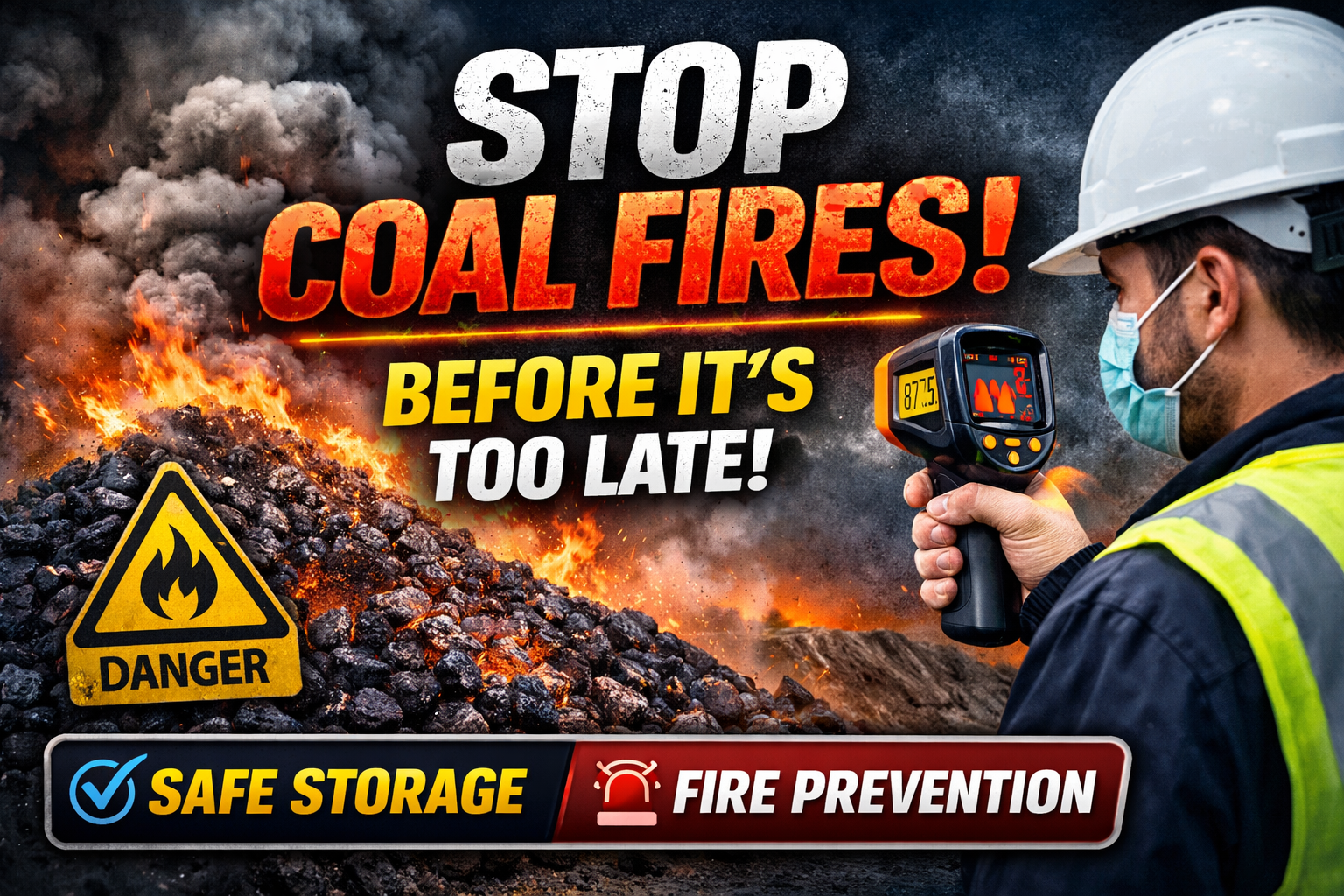
“Stop Coal Fires Before They Start – Smart Storage, Safer Operations.”
Introduction
Coal storage safety is one of the most critical aspects of industrial fuel management, especially when handling Indonesian coal (20–50 mm). Improper stockpile practices can lead to spontaneous combustion, smoke formation, and serious operational risks.
In many plants, coal fires don’t start suddenly—they develop silently due to internal heat buildup. This guide explains practical, field-tested methods to ensure coal storage safety, prevent stockpile fires, and maintain smooth plant operations.
Coal Storage Safety: Why Stockpile Fires Occur
Understanding the root cause is the first step toward improving coal storage safety.
Coal reacts with oxygen in a slow oxidation process:
- Heat is generated internally
- Heat gets trapped inside the pile
- Temperature rises gradually
- Fire develops without visible signs
🌡️ Temperature Stages
| Temperature | Condition |
|---|---|
| 30–50°C | Normal oxidation |
| 50–70°C | Self-heating begins |
| 70–90°C | Hot spots form |
| 90–120°C | Smoke appears |
| >120°C | Fire risk |
👉 By the time smoke appears, immediate action is required.
Best Practices for Coal Storage Safety in Industrial Yards
1. 📏 Maintain Optimum Pile Height
For effective coal storage safety:
- Ideal height: 3–5 meters
- Long-term storage: below 3 meters
👉 Lower piles dissipate heat better.
2. 📐 Use Proper Pile Shape
Avoid cone-shaped piles.
✅ Recommended:
- Long, flat stockpile
- Slope: 15°–30°
- Layer-by-layer compaction
👉 This improves coal storage safety by reducing oxygen entry.
3. 🧱 Prepare a Dry Storage Base
- Use concrete or compacted soil
- Ensure proper drainage
- Avoid water accumulation
👉 Moisture accelerates oxidation and reduces coal storage safety.
4. 🔁 Follow FIFO Strategy
First In → First Out
- Avoid long idle storage
- Use coal within 30 days (Indonesian coal)
👉 Old coal pockets are a major fire risk.
5. 📦 Layer-wise Stacking
- Spread in 300–500 mm layers
- Compact each layer
- Avoid dropping coal from height
👉 This minimizes air gaps and improves coal storage safety.
Coal Storage Safety Monitoring and Temperature Control
Monitoring is the backbone of effective coal storage safety.
🔧 Tools Required
- Temperature probe
- Infrared thermometer
- Thermal camera
- CO gas detector
📍 Monitoring Method
- Measure at 0.5–1.5 m depth
- Check every 5–10 meters
🚨 Action Levels
| Temperature | Action |
|---|---|
| <50°C | Safe |
| 50–60°C | Monitor |
| 60–70°C | Preventive action |
| >70°C | Emergency |
👉 Never ignore temperatures above 60°C.
Early Warning Signs (Critical for Coal Storage Safety)
Train your team to identify:
- Burning smell
- Smoke or vapor
- Surface cracks
- Hot zones
- Color change
👉 Early detection = stronger coal storage safety
Emergency Actions for Coal Stockpile Fires
When smoke appears, follow controlled action.
❌ DO NOT:
- Use heavy water jets
- Break pile suddenly
- Dig directly into hot spot
👉 These actions worsen the situation.
✅ Correct Procedure
- Identify hot zone
- Isolate area
- Remove coal gradually from edges
- Spread coal (<0.5 m thickness)
- Apply water mist (not jet)
- Monitor continuously
👉 This controlled approach ensures coal storage safety.
🧯 Fire Prevention Infrastructure
Every coal yard must have:
- Water spray system
- Fire hydrants
- Thermal monitoring system
- Loader/dozer availability
- Emergency access roads
👉 Preparedness is key to coal storage safety.
Special Considerations for Indonesian Coal
Indonesian coal requires extra attention for coal storage safety due to:
- High moisture content
- High volatile matter
- Low ignition temperature
✅ Best Practice Setup
- Pile height: 3 meters
- Storage duration: <30 days
- Continuous monitoring
- Strict FIFO
👉 These reduce spontaneous combustion risk.
Daily Coal Storage Safety Checklist
✔ Temperature measurement
✔ Visual inspection
✔ Odor detection
✔ Moisture check
✔ Equipment readiness
✔ Logbook update
👉 Daily discipline ensures long-term coal storage safety.
Impact of Poor Coal Storage Safety
Ignoring proper practices can lead to:
- 5–15% coal loss
- Fire hazards
- Production downtime
- Safety risks
- Environmental damage
Industry References (External Resources)
For enhanced coal storage safety, refer to:
- NFPA fire safety guidelines
- Industrial fuel handling standards
- Research on coal spontaneous combustion
Expert Tips for Coal Storage Safety
- Avoid long-term storage “just in case”
- Train operators regularly
- Use thermal cameras for monitoring
- Separate fresh and old coal
- Maintain proper records
FAQs on Coal Storage Safety
❓ Why does coal catch fire in stockpiles?
Due to slow oxidation and internal heat buildup.
❓ Which coal is most risky?
Low-rank coal like Indonesian coal.
❓ What is safe temperature?
Below 50°C is considered safe.
❓ Can water stop coal fire?
Yes, but only controlled mist application.
❓ Safe storage duration?
Less than 30 days for Indonesian coal.
Conclusion
Coal storage safety is not a one-time setup—it is a continuous operational discipline.
By combining:
- Smart stockpile design
- Strict FIFO practice
- Continuous monitoring
You can eliminate the risk of coal fires and ensure safe, efficient plant operations.
👉 Remember:
Prevention is always better than firefighting.