
📌 Introduction
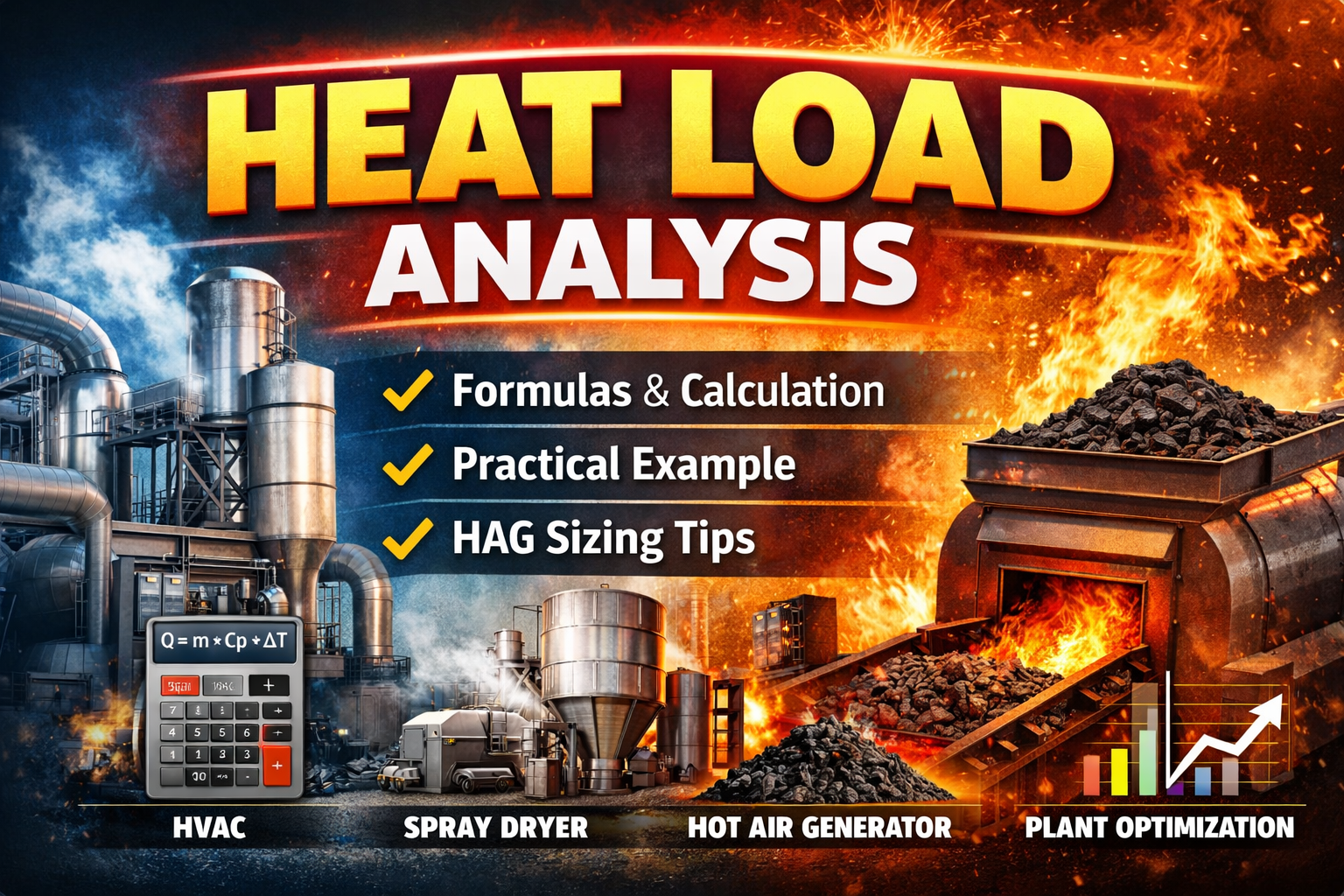
Heat load analysis is the backbone of thermal system design. Whether you are working on HVAC systems, spray dryers (SPD), boilers, or hot air generators (HAG), understanding heat load is critical for efficiency and cost optimization.
In simple terms, heat load is the total heat energy required to maintain a system at desired conditions.
In real industrial applications, it’s not just about formulas — it’s about assumptions, accuracy, and engineering judgment.
What is Heat Load?
Heat load is defined as:
👉 Total energy required to:
- Increase temperature (sensible heat)
- Evaporate moisture (latent heat)
- Compensate for system losses
🔍 Types of Heat Load
1. Sensible Heat Load
Heat required to increase temperature without phase change.
Formula:
Q = m × Cp × ΔT
Where:
- m = mass (kg/hr)
- Cp = specific heat (kcal/kg°C)
- ΔT = temperature difference (°C)
2. Latent Heat Load
Heat required for phase change (water → vapor).
Formula:
Q = m × λ
Where:
- λ = latent heat (~540 kcal/kg for water)
3. Heat Losses
Includes:
- Radiation losses
- Convection losses
- Air leakage
👉 Typically assumed: 5–15% of total heat load
Practical Example: Spray Dryer Heat Load Calculation
Let’s take a real industrial case similar to an SPD plant.
📥 Given Data
Feed rate = 900 kg/hr
Product output = 500 kg/hr
Water evaporation = 400 kg/hr
Air temperature = 30°C to 190°C
Cp of air = 0.24 kcal/kg°C
Air flow = 10800 m³/hr
Air density = 1.2 kg/m³
Step 1: Air Mass Flow
m = Volume × Density
m = 10800 × 1.2
m = 12960 kg/hr
Step 2: Sensible Heat (Air Heating)
Q = m × Cp × ΔT
Q = 12960 × 0.24 × (190 - 30)
Q = 12960 × 0.24 × 160
Q = 497664 kcal/hr
Step 3: Latent Heat (Evaporation)
Q = m × λ
Q = 400 × 540
Q = 216000 kcal/hr
Step 4: Product Heating
Cp = 0.5 kcal/kg°CQ = 500 × 0.5 × (190 - 30)
Q = 500 × 0.5 × 160
Q = 40000 kcal/hr
Step 5: Total Heat Before Loss
Total = 497664 + 216000 + 40000
Total = 753664 kcal/hr
Step 6: Add Heat Loss (10%)
Loss = 0.10 × 753664
Loss = 75366 kcal/hr
Final Heat Load
Q_total = 753664 + 75366
Q_total ≈ 829000 kcal/hr
Hot Air Generator (HAG) Sizing
Now convert heat load into fuel requirement.
Given:
Coal CV = 4000 kcal/kg
Efficiency = 0.7
Formula:
Coal required = Q / (CV × Efficiency)
Calculation:
Coal = 829000 / (4000 × 0.7)
Coal = 829000 / 2800
Coal ≈ 296 kg/hr
Final Recommendation
👉 Based on calculation:
- Heat Load ≈ 830,000 kcal/hr
- Coal Requirement ≈ 300 kg/hr
- Recommended HAG Capacity ≈ 1.0 – 1.2 Million kcal/hr
Key Factors Affecting Heat Load
1. Moisture Content
Higher moisture → higher latent heat
2. Air Temperature
Higher temperature → more sensible heat
3. System Efficiency
Poor insulation increases fuel consumption
4. Air Leakage
Uncontrolled airflow reduces system efficiency
Common Mistakes Engineers Make
- Ignoring heat losses
- Using incorrect Cp values
- Not considering ambient conditions
- Oversizing (fuel wastage)
- Undersizing (production loss)
Optimization Tips (Expert Level)
🔹 Use Waste Heat Recovery
Save 10–20% energy
🔹 Improve Insulation
Reduces heat losses
🔹 Optimize Air Flow
Balance FD and ID blowers
🔹 Automate Temperature Control
Avoid overheating
Industrial Applications
Heat load analysis is widely used in:
- Spray Dryers (SPD)
- Hot Air Generators (HAG)
- Boilers
- HVAC Systems
- Food Processing Plants
- Chemical Industries
Quick Reference Table
| Component | Formula |
|---|---|
| Sensible Heat | m × Cp × ΔT |
| Latent Heat | m × λ |
| Coal Required | Q / (CV × Efficiency) |
| Air Mass Flow | Volume × Density |
❓ Frequently Asked Questions (FAQ)
Q1. What is the most important factor?
👉 Moisture evaporation (latent heat dominates)
Q2. Why add safety margin?
👉 To handle:
- Ambient variation
- Efficiency losses
- Future expansion
Q3. What if HAG is undersized?
👉 Results in:
- Low temperature
- Incomplete drying
- Production loss
Q4. Can fuel consumption be reduced?
👉 Yes, by:
- Heat recovery
- Better insulation
- Airflow optimization
Q5. Coal vs Gas – Which is better?
| Factor | Coal | Gas |
|---|---|---|
| Cost | Low | High |
| Control | Medium | Excellent |
| Maintenance | High | Low |
Final Thoughts
Heat load analysis is not just a calculation — it’s a decision-making tool.
A well-designed system:
✔ Saves fuel
✔ Improves efficiency
✔ Increases reliability
Bonus Tip (Industry Insight)
👉 Always design your system at 80% efficiency, not 100%.
Because real systems never operate under ideal conditions.