

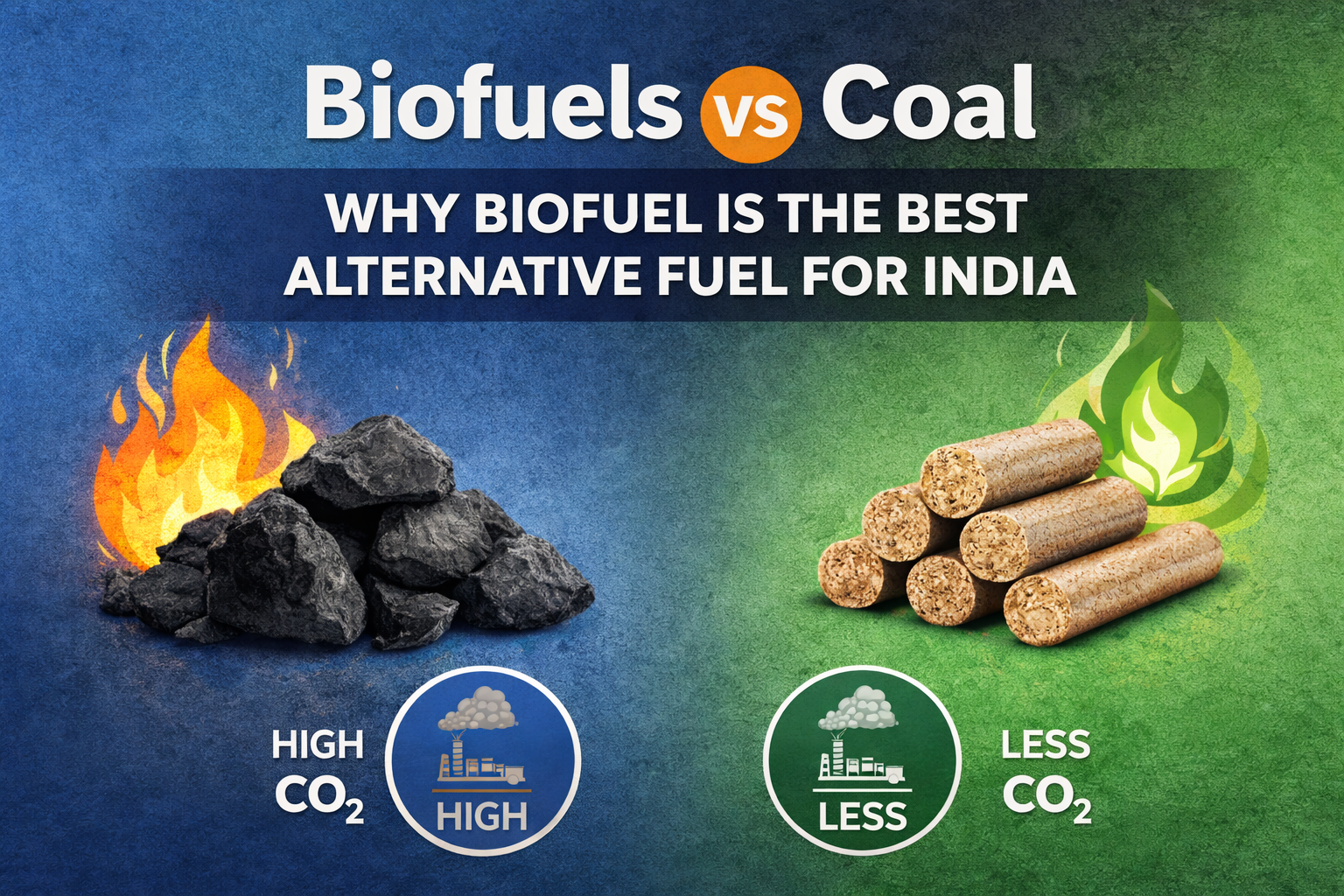
A Technical Case Study for Industrial Energy Transition
By Devendra Singh
Introduction: India’s Growing Fuel Challenge
India is currently at a crucial point in its energy journey. Industrial growth, rapid urbanization, and increasing power demand are pushing the country to consume massive amounts of fuel every year. For decades, coal has been the backbone of India’s industrial and power sectors, powering boilers, thermal plants, and manufacturing facilities.
However, the situation is changing rapidly.
In recent years, industries have faced:
- Coal supply shortages
- Rising fuel costs
- Logistics challenges in coal transportation
- Strict environmental regulations
- Increasing carbon emission concerns
These challenges have forced engineers, plant managers, and policymakers to search for sustainable and reliable fuel alternatives.
Among all possible options, biofuel—especially biomass briquettes and pellets—has emerged as one of the most practical alternatives to coal in India.
This article from Engineering’s Diary presents a technical case study comparing coal and biofuels, focusing on key parameters such as:
- Calorific value
- Ash content
- Combustion efficiency
- Environmental impact
- Industrial feasibility
Understanding Biofuels
Biofuels are fuels produced from biological organic materials, commonly known as biomass.
These materials include agricultural waste such as:
- Rice husk
- Wheat straw
- Cotton stalk
- Sawdust
- Groundnut shells
- Sugarcane bagasse
Through mechanical compression processes, these residues are converted into biomass briquettes or pellets, which are often called white coal.
Unlike fossil fuels, biofuels are renewable and sustainable because they originate from plant materials that can regrow every season.
This makes biofuels particularly suitable for a country like India where agricultural waste is abundantly available.
Why Coal is Becoming a Challenge for Indian Industries
Although coal has traditionally been considered a cheap energy source, it comes with several technical and operational limitations.
1. High Ash Content
One of the biggest drawbacks of Indian coal is its high ash percentage, which usually ranges between:
25% – 45%
High ash leads to:
- Slag formation in boilers
- Higher maintenance costs
- Increased particulate emissions
- Frequent cleaning shutdowns
This reduces overall boiler efficiency.
2. Lower Calorific Value
Calorific value is the amount of energy released during combustion.
Typical calorific value of fuels:
| Fuel | Calorific Value |
|---|---|
| Indian Coal | 3000 – 4300 kcal/kg |
| Imported Coal | 5000 – 6500 kcal/kg |
| Biomass Briquettes | 3500 – 5000 kcal/kg |
Although imported coal has higher calorific value, its cost is significantly higher due to international market fluctuations and transportation expenses.
Biofuels offer a competitive calorific value close to medium-grade coal, making them suitable for many industrial applications.
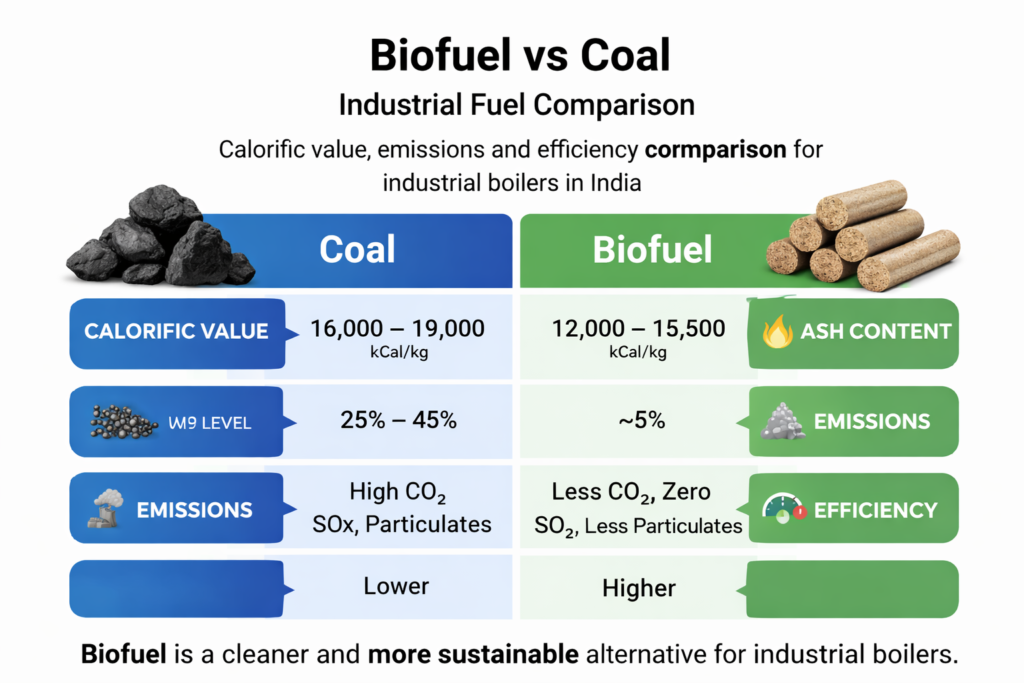
Technical Comparison: Coal vs Biofuel
Below is a simplified engineering comparison.
| Parameter | Coal | Biofuel |
|---|---|---|
| Calorific Value | 3000–4300 kcal/kg | 3500–5000 kcal/kg |
| Ash Content | 25–45% | 5–8% |
| Moisture Content | 10–20% | 5–10% |
| Sulphur Content | High | Very Low |
| Carbon Emissions | High | Near Carbon Neutral |
| Renewable | No | Yes |
From a technical perspective, biofuel offers better combustion characteristics with lower environmental impact.
Industrial Case Study: Boiler Fuel Replacement
Let us analyze a real industrial scenario.
Plant Type
Medium scale manufacturing plant operating a 10 TPH steam boiler.
Current Fuel
Coal
- Calorific value = 4000 kcal/kg
- Boiler efficiency = 70%
Proposed Fuel
Biomass briquettes
- Calorific value = 4200 kcal/kg
- Boiler efficiency = 75%
Energy Requirement
Approximate heat required for 10 TPH steam generation:
6.5 million kcal per hour
Coal Consumption
Coal required:
2.32 tons per hour
Biomass Consumption
Biomass required:
2.06 tons per hour
Result
Switching to biomass results in:
- 10–12% reduction in fuel consumption
- Significant reduction in ash generation
- Lower emission levels
Additionally, biomass boilers typically experience less clinker formation and improved combustion stability.
Environmental Benefits of Biofuels
Coal combustion releases significant quantities of harmful gases including:
- Carbon dioxide (CO₂)
- Sulphur dioxide (SO₂)
- Nitrogen oxides (NOx)
These gases contribute to:
- Climate change
- Acid rain
- Air pollution
Biofuels, on the other hand, are considered carbon neutral because the carbon released during combustion is approximately equal to the carbon absorbed by plants during growth.
Key environmental benefits include:
- Reduced greenhouse gas emissions
- Lower particulate pollution
- Minimal sulphur emissions
- Reduced landfill waste
Agricultural Waste: India’s Untapped Energy Source
India generates over 500 million tons of agricultural residue every year.
Unfortunately, a large portion of this biomass is burned in fields, leading to severe air pollution, especially in northern India.
If even a fraction of this agricultural waste is converted into biofuel, it could:
- Provide sustainable fuel for industries
- Reduce crop burning pollution
- Create rural employment
- Strengthen India’s circular economy
Economic Advantages for Industries
From an industrial perspective, biofuels offer several cost advantages.
Stable Pricing
Coal prices fluctuate due to:
- Global market changes
- Transportation issues
- Mining limitations
Biomass fuels are typically locally sourced, resulting in more stable pricing.
Reduced Boiler Maintenance
Lower ash results in:
- Reduced soot accumulation
- Less slag formation
- Lower maintenance downtime
Carbon Credit Opportunities
Industries switching to biomass can benefit from carbon credit mechanisms, helping offset operational costs.
Government Support for Biofuels in India
Recognizing the potential of bioenergy, the Indian government has launched several initiatives:
- National Bioenergy Mission
- Biomass co-firing programs in thermal power plants
- Promotion of bio-CNG and ethanol blending
These policies aim to reduce dependence on fossil fuels and encourage renewable energy adoption.
Challenges in Biofuel Adoption
Despite its advantages, biofuel adoption still faces some challenges.
Supply Chain Development
Biomass collection, processing, and distribution infrastructure needs further development.
Storage Conditions
Biomass requires proper dry storage to prevent moisture absorption.
Boiler Design Modifications
Some boilers may require fuel feeding system adjustments to efficiently burn briquettes or pellets.
However, these are engineering challenges that can be solved with proper system design.
The Future: Hybrid Fuel Systems
The most realistic approach for industries may not be complete coal replacement immediately.
Instead, many plants are adopting co-firing systems, where coal is mixed with biomass.
Typical ratios include:
- 10% biomass blending
- 20% biomass blending
- Up to 50% in advanced systems
This allows industries to gradually transition toward cleaner fuels.
Why Biofuel is the Best Alternative Fuel for India
Based on technical, environmental, and economic analysis, biofuel emerges as a highly practical solution for India’s energy transition.
Major advantages include:
✔ Comparable calorific value to coal
✔ Significantly lower ash content
✔ Renewable fuel source
✔ Lower emissions
✔ Supports rural economy
✔ Reduces agricultural waste burning
For industries seeking sustainable and cost-effective fuel solutions, biomass fuels represent a promising path forward.
Final Thoughts
India’s energy future cannot rely solely on fossil fuels. While coal will continue to play an important role in the short term, the long-term strategy must include cleaner and renewable alternatives.
Biofuels provide a balanced solution that combines engineering practicality with environmental responsibility.
By converting agricultural waste into usable energy, India can reduce pollution, strengthen rural economies, and build a more sustainable industrial ecosystem.
The transition may take time, but the direction is clear:
Biofuel is not just an alternative fuel—it is a strategic energy solution for India’s future.
FAQs
Is biofuel cheaper than coal in India?
In many regions, biomass briquettes are competitively priced and can become cheaper when transportation and ash disposal costs of coal are considered.
Can biofuel fully replace coal in boilers?
Yes, in many industrial boilers biomass can fully replace coal. However, some systems may require burner or feeding system modifications.
What is the calorific value of biomass briquettes?
Typically between 3500 and 5000 kcal/kg, depending on the raw material used.
Is biomass fuel environmentally friendly?
Yes. Biomass is considered carbon neutral and produces significantly lower sulphur and ash emissions compared to coal.