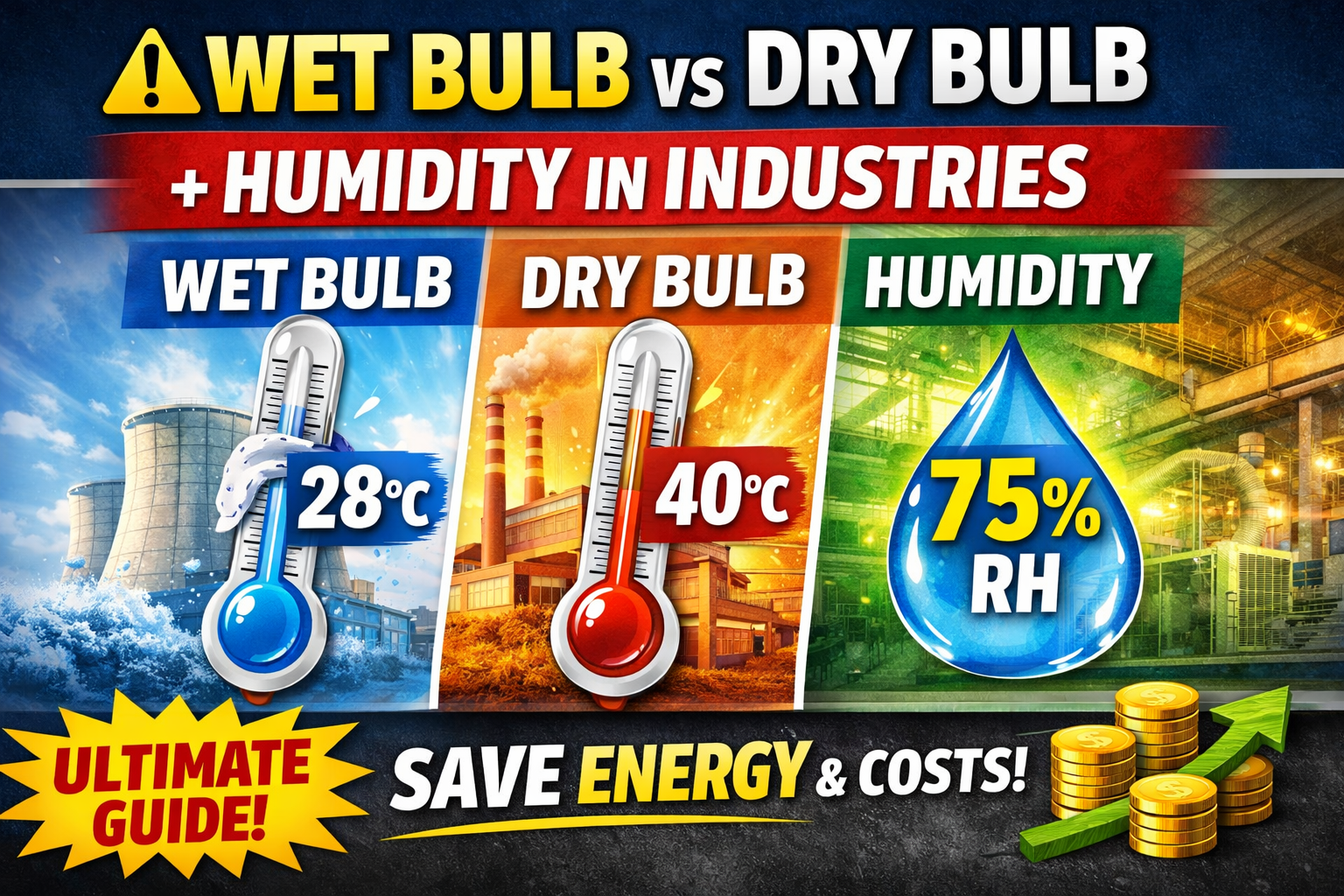

Controlling moisture is one of the most crucial requirements across chemical manufacturing, compressor stations, petroleum plants, HVAC systems, process industries, and storage facilities. Moisture—if not properly monitored—can cause corrosion, equipment failures, contamination, hydrate formation in pipelines, and even product quality deterioration.
This is why industries rely on a key moisture indicator known as dew point temperature.
In this article, you will learn:
- What is meant by dew point temperature?
- What is a good dew point temperature for different industrial applications?
- How to calculate dew point temperature (with formulas & examples)
- The difference between dew point & humidity
- Instruments used to measure dew point
- Numerical examples for college students
- Moisture control & drying techniques used in plants
This article is written in simple, human language—ideal for students, beginners, and industry professionals.
1. What Is Meant by Dew Point Temperature?
Dew point temperature is the temperature at which the water vapor present in air starts condensing into liquid water when air is cooled at constant pressure.
At the dew point:
- Air becomes fully saturated
- Relative humidity becomes 100%
- Condensation begins on surfaces
Simple explanation:
Dew point is the exact temperature where moisture becomes visible as droplets.
Example:
If air at 35°C must be cooled to 25°C for water droplets to appear, then the dew point = 25°C.
2. Why Dew Point Measurement Is Important in Industries
Moisture causes severe problems in industries:
| Industry | Impact of Moisture |
|---|---|
| Chemical plants | Unwanted side reactions, corrosion, poor product quality |
| Sulphonation & LABSA plants | Moisture interferes with SO₃ gas & reduces purity |
| Compressed air systems | Valve sticking, instrument failure |
| Natural gas | Hydrate formation & pipeline blockages |
| HVAC | Mold, condensation, poor comfort |
| Food & pharma | Spoilage, caking, stability issues |
Accurate dew point measurement helps maintain safe, efficient, and reliable plant operations.
3. What Is a Good Dew Point Temperature?
There is no universal “good” dew point—it depends on the process.
Ideal Dew Point Ranges in Industries
| Application | Recommended Dew Point |
|---|---|
| Instrument/Plant Air | –40°C to –20°C |
| ISO Dry Compressed Air | –40°C |
| Refrigerated Air Dryer | +3°C |
| Natural Gas Pipelines | –10°C to –20°C |
| HVAC / Comfort | 10°C – 17°C |
| Pharmaceutical Cleanrooms | 0°C – 10°C |
Rule:
Lower dew point = drier air = safer for industrial applications.
4. How to Calculate Dew Point Temperature (HTML Formulas Below)
The most widely used calculation method is the Magnus Formula. It relates air temperature (T) and relative humidity (RH) to estimate dew point temperature.
5. Dew Point vs Humidity — What’s the Difference?
Many people confuse dew point with humidity. They are related but not the same.
Humidity (Relative Humidity %)
- Measures how full the air is with moisture
- Depends on temperature
- Does not directly tell actual moisture mass
Dew Point Temperature
- A direct indicator of absolute moisture
- Does not change with air temperature
- More accurate for industrial use
Easy way to remember:
Humidity tells how full the air is.
Dew point tells how much water is really there.
6. Dew Point Measurement Instruments Used in Industry
1. Chilled Mirror Hygrometer
- Measures the temperature at which condensation forms on a mirror
- Highly accurate
- Used in calibration labs
2. Capacitive Dew Point Sensors
- Most common industrial sensors
- Compact and reliable
- Used in compressed air dryers
3. Aluminum Oxide Dew Point Sensors
- Measure extremely low dew points (–100°C)
- Ideal for natural gas & petrochemicals
4. Wet & Dry Bulb (Psychrometric) Method
- Traditional method
- Used in HVAC & environmental engineering
7. Dew Point in Critical Industrial Sectors
✔ Chemical & Sulphonation Plants
Moisture affects SO₃ gas reactions and product purity.
Dew point directly impacts LABSA quality.
✔ Compressed Air Systems
Moisture causes:
- Actuator sticking
- Corrosion
- Instrument malfunction
Standard: –40°C dew point
✔ Natural Gas Pipeline Operations
High moisture forms hydrates.
Typical dew point limit: –10°C to –20°C
✔ HVAC Systems
Comfort depends heavily on dew point, not just humidity.
Ideal indoor dew point: 10°C–17°C
8. Easy Numerical Examples for Students
Example 1
Instrument air dew point required = –40°C
Actual dryer output = –25°C
→ Air is not dry enough.
→ Moisture may damage pneumatic valves.
Example 2
Dew point rises from 5°C to 18°C over a day.
→ Moisture content has increased significantly.
→ Higher risk of condensation.
Example 3
Dry bulb = 25°C
Wet bulb = 20°C
→ Dew point from psychrometric chart = ~16°C
9. How Industries Reduce Dew Point
✔ Refrigeration Dryers
Dew point: +3°C
Used widely in normal compressed air systems.
✔ Desiccant Dryers
Dew point: –40°C to –70°C
Used for instrument air and sensitive operations.
✔ Membrane Dryers
Portable and maintenance-friendly.
✔ Automatic Condensate Drains
Remove accumulated moisture in pipelines.
10. Summary
Dew point temperature is the most accurate indicator of moisture in air or gas. It tells you the exact temperature at which condensation occurs, helping industries prevent corrosion, hydrate formation, contamination, and quality loss. Understanding dew point is essential for chemical plants, compressed air systems, natural gas pipelines, and HVAC engineering.
With the Magnus formula and examples, students and engineers can easily calculate and interpret dew point.
11. FAQs
What is meant by dew point temperature?
The temperature at which air becomes fully saturated and water vapor begins to condense.
What is a good dew point temperature?
For industry: –40°C (instrument air), –10°C to –20°C (natural gas).
For comfort: 10°C–17°C.
How do you calculate dew point temperature?
Using the Magnus formula (see HTML block above).
What’s the difference between dew point and humidity?
Humidity is a percentage; dew point is an exact temperature showing absolute moisture.