

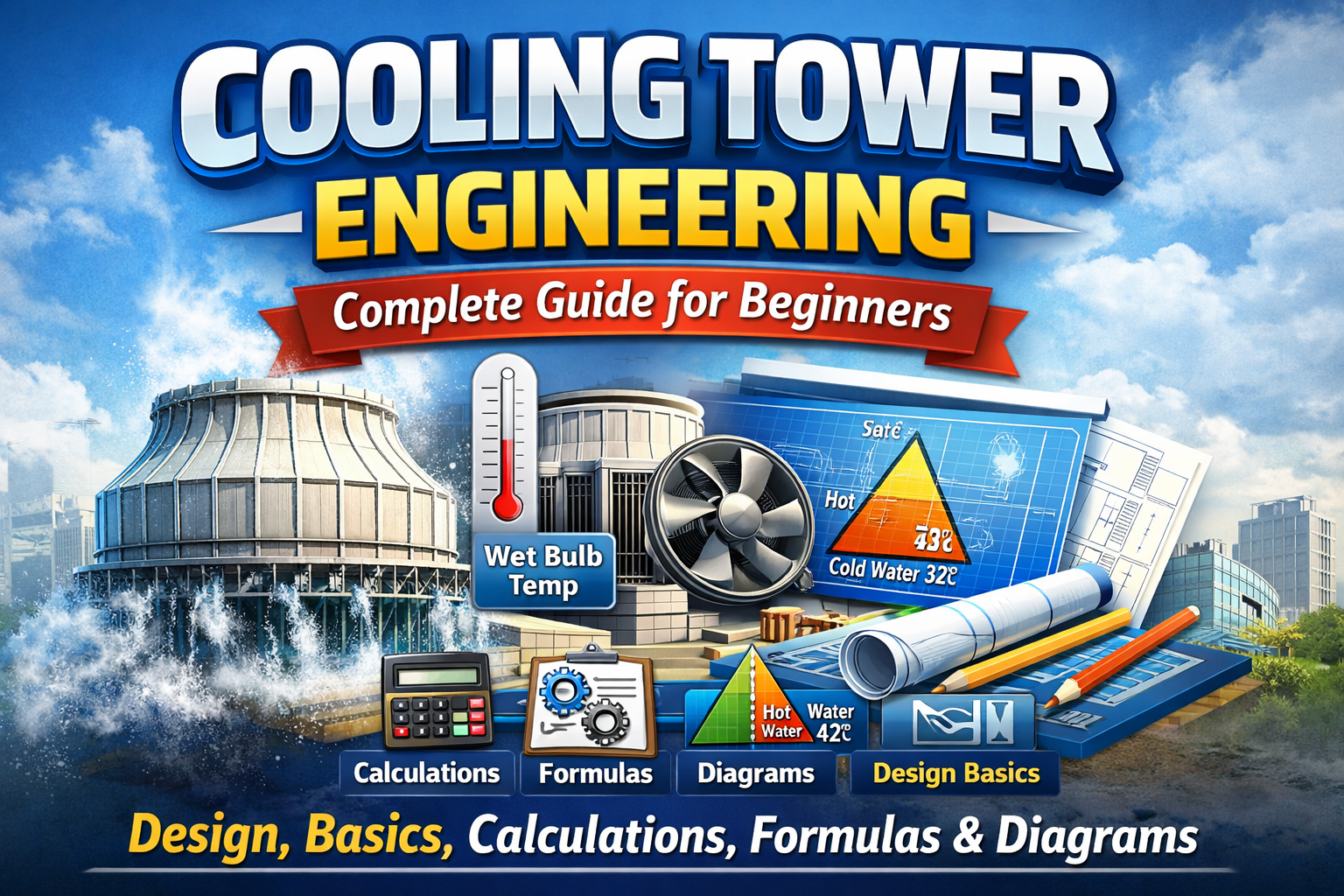
Cooling towers are among the most critical utility systems in any industrial plant—chemical, pharma, power, refinery, HVAC, steel, and more. They ensure reliable process cooling by rejecting heat to the atmosphere through evaporation. A deep understanding of cooling tower working principles, design basics, and performance calculations is essential for any engineer involved in utilities, operations, maintenance, process, or project engineering.
This guide is written for beginners but structured with the depth of an industry expert. By the end, you will fully understand cooling tower fundamentals, performance parameters, calculations, and selection guidelines.
1. What is a Cooling Tower?
A cooling tower is a heat-rejection device that cools down hot water by bringing it into contact with ambient air. A small portion of water evaporates during this contact, removing heat from the remaining water.
Key principle:
Evaporative cooling — when water evaporates, it absorbs heat (latent heat of vaporization), thus cooling the water.
Cooling towers are used in:
- Power plants (condenser cooling)
- Chemical & pharmaceutical industries
- HVAC systems (chiller cooling)
- Steel & cement plants
- Oil refineries & petrochemical complexes
2. Cooling Tower Working Principle (Simplified)
- Hot water from the process enters the tower and is sprayed over fill media.
- Fans draw or push air through the tower.
- Air picks up heat from water through:
- Evaporation (major contribution)
- Convection
- Evaporation (major contribution)
- A small fraction of water evaporates, causing the remaining water to cool.
- Cold water collects in the basin and returns to the process.
3. Types of Cooling Towers
A. Based on Air Flow
- Induced Draft (most common)
- Fan at the top pulls air upward.
- Energy efficient and widely used.
- Fan at the top pulls air upward.
- Forced Draft
- Fan at air inlet pushes air inside.
- Fan at air inlet pushes air inside.
- Natural Draft
- Uses chimney effect; no electrical fan.
- Used in large power plants.
- Uses chimney effect; no electrical fan.
B. Based on Construction
- Counterflow Towers
- Air flows upward, water flows downward.
- Air flows upward, water flows downward.
- Crossflow Towers
- Air flows horizontally across falling water.
- Air flows horizontally across falling water.
4. Key Cooling Tower Components
- Hot Water Distribution System – nozzles, headers
- Fill Media – splash or film fill
- Drift Eliminators
- Louvers
- Fan & Motor
- Casing & Structure
- Cold Water Basin
- Make-up Water System
- Bleed-Off/Blowdown Line
5. Psychrometric Basics for Cooling Towers
Dry Bulb Temperature (DBT)
Normal air temperature measured by a thermometer exposed to air.
Wet Bulb Temperature (WBT)
Lowest temperature air can be cooled to by evaporation of water at constant pressure.
Critical point:
Cooling towers cannot cool water below WBT.
Relative Humidity (RH)
Amount of moisture in air relative to its moisture-holding capacity.
Why WBT matters?
It defines the theoretical limit of cooling.
6. Cooling Tower Key Performance Parameters
1. Range
Range=Thot−Tcold\text{Range} = T_{\text{hot}} – T_{\text{cold}}Range=Thot−Tcold
Example:
Hot water = 40°C
Cold water = 32°C
Range = 8°C
2. Approach
Approach=Tcold−TWBT\text{Approach} = T_{\text{cold}} – T_{\text{WBT}}Approach=Tcold−TWBT
Example:
Cold water = 32°C
WBT = 27°C
Approach = 5°C
Smaller approach = better tower performance.
3. Cooling Capacity (kcal/h or kW)
Q=m×Cp×ΔTQ = m \times Cp \times \Delta TQ=m×Cp×ΔT
Where:
- mmm = water flow (m³/hr × 1000 = kg/hr)
- CpCpCp = 1 kcal/kg°C
Example:
Water flow = 100 m³/hr
Range = 8°C
Q=100,000×1×8=800,000 kcal/hrQ = 100,000 \times 1 \times 8 = 800,000 \text{ kcal/hr}Q=100,000×1×8=800,000 kcal/hr
Convert to kW:
kW=kcal/hr860=800,000860=930 kW\text{kW} = \frac{\text{kcal/hr}}{860} = \frac{800,000}{860} = 930 \text{ kW}kW=860kcal/hr=860800,000=930 kW
4. Evaporation Loss
Evaporation Loss (m³/hr)=Range100×Circulation flow\text{Evaporation Loss (m³/hr)} = \frac{\text{Range}}{100} \times \text{Circulation flow}Evaporation Loss (m³/hr)=100Range×Circulation flow
Rule of thumb:
Evaporation=0.68% of circulation per 5.56°C drop\text{Evaporation} = 0.68\% \text{ of circulation per } 5.56°C \text{ drop}Evaporation=0.68% of circulation per 5.56°C drop
Example:
Range = 8°C
Flow = 100 m³/hr
Evaporation ≈ 1.2 m³/hr
5. Drift Loss
Very small:
Drift=0.02% of circulation\text{Drift} = 0.02\% \text{ of circulation}Drift=0.02% of circulation
(if drift eliminators are good)
6. Blowdown (Bleed Off)
Controls cycles of concentration (COC).
Blowdown=EvaporationCOC−1\text{Blowdown} = \frac{\text{Evaporation}}{\text{COC}-1}Blowdown=COC−1Evaporation
Example:
Evaporation = 1.2 m³/hr
COC = 4
Blowdown = 1.2 / 3 = 0.4 m³/hr
7. Make-up Water Requirement
Make-up=Evaporation+Drift+Blowdown\text{Make-up} = \text{Evaporation} + \text{Drift} + \text{Blowdown}Make-up=Evaporation+Drift+Blowdown
Example:
1.2 + 0.02 + 0.4 = 1.62 m³/hr
7. Cooling Tower Fan Power Calculation (Basic)
P=Q×ΔPη×102P = \frac{Q \times \Delta P}{\eta \times 102}P=η×102Q×ΔP
Where:
- QQQ = air volume flow (m³/s)
- ΔP\Delta PΔP = static pressure (mmWC)
- η\etaη = overall efficiency
8. Heat Transfer Mechanism Inside Cooling Tower
Evaporation
85–90% of heat removed
(latent heat: 540 kcal/kg at 32°C)
Sensible Heat Transfer
10–15%
9. Wet Bulb Temperature – Explained with Example
Statement:
“WBT is the lowest temperature air can be cooled to by evaporation at constant pressure.”
Meaning:
If you wrap a thermometer bulb in wet cloth and blow air on it, it cools due to evaporation. It stops cooling at the WBT – this is the limit for evaporative cooling.
Example:
DBT = 35°C
RH = 50%
WBT ≈ 26°C
Even the best cooling tower cannot cool water below 26°C in this condition.
10. Psychrometric Chart Use for Cooling Tower
On the chart:
- Plot DBT.
- Move to the RH line to find the air state.
- Move along constant enthalpy line to saturation curve → WBT.
- Cooling tower performance depends on WBT and humidity ratio.
11. Heat Load Calculation – Practical Example
Given:
- Flow = 150 m³/hr
- Hot water = 42°C
- Cold water = 33°C
- WBT = 27°C
Step 1 – Range
42 – 33 = 9°C
Step 2 – Approach
33 – 27 = 6°C
Step 3 – Cooling capacity
Q=150,000×1×9=1,350,000 kcal/hrQ = 150,000 \times 1 \times 9 = 1,350,000 \text{ kcal/hr}Q=150,000×1×9=1,350,000 kcal/hr
Convert to kW:
1,350,000/860=1,569.8 kW1,350,000 / 860 = 1,569.8 \text{ kW}1,350,000/860=1,569.8 kW
12. Cooling Tower Selection – What to Consider
- Required cooling capacity (kcal/hr or kW)
- Flow rate (m³/hr)
- Expected range & approach
- Site wet bulb temperature
- Type: induced or forced draft
- Material: FRP, HDG steel, RCC
- Fill type: film or splash
- Fan type: axial or centrifugal
- Cycles of concentration (water quality)
- Space availability
13. Best Practices for Cooling Tower Efficiency
✔ Maintain Approach
Approach < 5°C gives excellent performance (if WBT allows).
✔ Ensure Clean Fill
Scaling reduces surface area → lowers cooling.
✔ Maintain Fan Belt Tension
Loose belts reduce air flow.
✔ Maintain Correct COC
Higher COC saves water but increases scaling.
✔ Ensure Proper Air Flow
No air short-circuiting around tower.
✔ Keep Drift Eliminators Clean
Reduces drift loss and PM emission.
14. Troubleshooting Cooling Tower Problems
Problem: Cold water temperature rising
Causes:
- High wet bulb due to climatic conditions
- Scaling in fill
- Insufficient airflow
- Damaged nozzles
- Incorrect fan rotation
Problem: Excess water consumption
Causes:
- High drift
- Excess blowdown
- Low COC
- High evaporation due to high range
15. Cooling Tower Diagram (Included in Next Message)
The diagram will include:
- Counterflow & crossflow tower structure
- Water & air paths
- Fill, drift eliminator, fan
- Hot and cold water lines
- Psychrometric WBT explanation
16. Summary
Cooling towers work on evaporative cooling and the wet-bulb temperature fundamentally limits performance. Understanding range, approach, COC, evaporation, drift, blowdown, and make-up water is essential for operation and design.
This guide covers design basics, working principle, formulas, calculations, examples, and practical engineering aspects — everything a beginner needs to become confident in cooling tower engineering.
Fascinating blog! Is your theme custom made or did you download it from somewhere? A design like yours with a few simple tweeks would really make my blog stand out. Please let me know where you got your design. Thanks a lot
It was made using Astra Theme